
Research Thesis
Title
Computational Approaches to Understand host pathogen interactions in foot and mouth disease (FMD) of cattle
Abstract
Foot-and-mouth disease (FMD), being an extremely infectious viral disease in wild and domestic clovenhoofed animals, endangers several livestock populations nurtured in India. FMD adversely affects the socioeconomic status of millions of farmers. Though considerable amount of genomic information related to FMD is available, it has remained as a major threat to the livestock industry world-wide. The high genetic variability in the FMDV genome limits the effectiveness of vaccination. Moreover, traditional vaccine and drug development methods are time consuming. Hence, an intervention of bioinformatics approaches is required to supplement the rapid therapeutics development for FMD infected animals. Among these animals, cattle are highly affected by FMD that contribute substantially to the survival of mankind since several years. Therefore, the present study has been designed to explore the in silico aspects of therapeutics development against FMD in cattle. Specifically, the study includes development of a flexible length B-Cell epitope prediction method to supplement FMD therapeutics, computational designing of an effective therapeutic antibody that can address the problem of genetic variability in FMDV, unraveling the role of RNA interference in host-pathogen interaction and development of an information system on FMD of cattle that can assist related research community in controlling FMD in cattle. The performance of machine learning models like, Random Forest(RF) and Support Vector Machine (SVM) were assessed using the flexible length linear B-Cell epitope datasets encoded with nineteen different amino acid encoding schemes (feature vectors) including a proposed scheme. Out of these nineteen encoding schemes, Amino acid Composition(AC; 20 dimensional feature vector), Distribution component of Composition Transition Distribution(CTDD; 105 dimensional feature vector), Amino acid anchoring Pair Composition(APC; 1200 dimensional feature vector), Codon Degeneracy based Encoding(CDE; 16 dimensional feature vector), Di-Peptide Composition (DC; 400 dimensional feature vector) were combined based on their performance as well as length of the corresponding feature vectors. The combinations namely, AC+CTDD, CDE+CTDD and APC+AC+CTDD with RF model have exhibited high prediction accuracy while using specialized FMDV dataset. Whereas, the combination APC+DC with RF model showed high accuracy while using generalized homogeneous flexible length B-Cell epitope dataset. A similar trend was also observed while APC+DC with RF was compared with existing state-of-art methods for prediction of flexible length B-Cell epitopes while using an independent test set. As far as, the computational antibody design is concerned, six variants of the monoclonal antibody (mAb) 4C4 were identified with better binding potential than the native one. Amongst the 4C4 variants, the model with mutations at 2096 (N®C), 2098(D®I), 2599(A®G) and 2602(S®Q) positions was found most favorable for interacting with the antigen. Another 4C4 variant having mutations at 2034(N®L), 2096(N®C) 2098(D®Y), 2532(T®K) and 2599(A®G) positions confirmed better binding potential with two genetically variable GH loops of FMDV-VP1 protein than the native ones. In the context of RNAi mechanism in host pathogen interaction, nine mature host miRNAs were identified to have a total of 284 targets in 98 distinct FMDV genomic sequences. Futher, 14 miRBase miRNAs were found with better target accessibility in FMDV than that of Bos taurus. Besides, eight putative targetable regions having sense strand properties of siRNAs were identified on FMDV genes that are highly dissimilar from the host genome. In addition, 21 simulated nucleotide sequences having >90% identity with mature miRNAs were identified to have targets in FMDV accessions. The “Foot and Mouth Disease Information System for Cattle (FMDISC)” has been developed based on the information generated on antibodies, ncRNAs and epitopes related to FMD with user-friendly retrieval system. FMDISC also incorporates a flexible length linear B-Cell epitope prediction server (FlexiBcF), which is especially trained with the experimentally validated B-Cell epitopes related to FMD. The FMDISC is freely accessible at http://bioinformatics.iasri.res.in/fmdisc.
Publications (2)
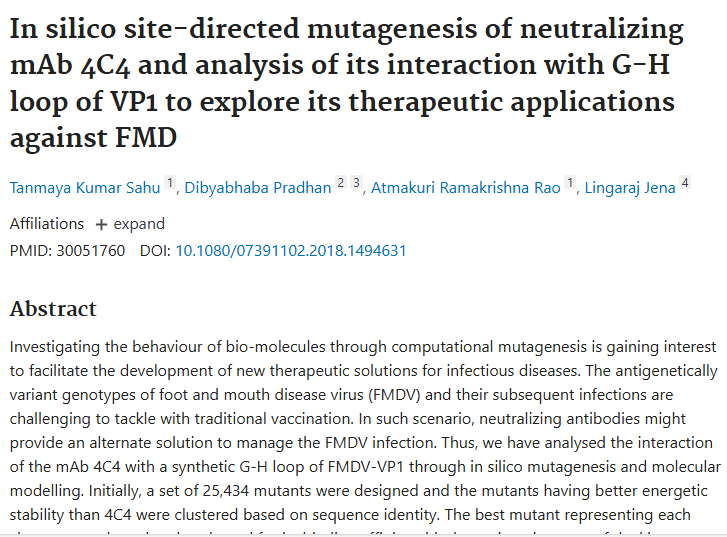
In silico site-directed mutagenesis of neutralizing monoclonal antibody 4C4 and analysis of its interaction with G-H loop of VP1 protein to explore its therapeutic applications against foot and mouth disease.
Sahu,T.K., Pradhan, D., Rao, A. R. and Jena, L
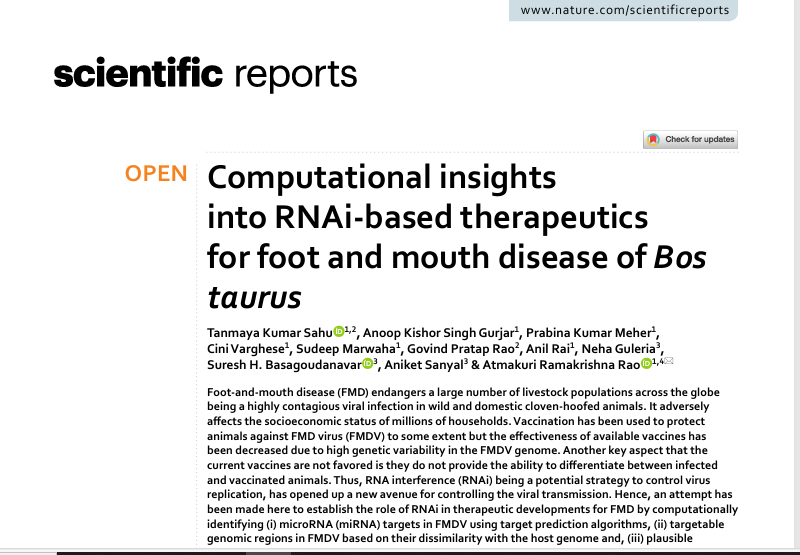
Computational insights into RNAi-based therapeutics for foot and mouth disease of Bos taurus.
Sahu, T.K., Gurjar, A.K.S., Meher, P.K. et al.