
Mamatha Y S
1
Publications
4 yr 7 mo
Duration
Research Thesis
Title
Multi-Omics Approaches for Drug Design and its Application in Animal Science
Objectives
1. To develop a methodology for drug design using multi-omics data 2. To design and develop a web tool for the proposed methodology 3. To identify the drug receptor for animal disease 4. To virtual screening of natural products for identified drug receptors
Abstract
Multi-omics approaches have transformed the understanding of complex molecular mechanisms by integrating diverse datasets. Key genes, as central regulators within molecular networks, offer critical insights into disease mechanisms, biomarkers, and therapeutic targets. However, single-omics studies fail to capture cross-omics interactions, necessitating integrative approaches. Despite this need, few studies have identified key genes using multi-omics data. To address this gap, we introduce MultiKey, an R Shiny application (https://iasri.shinyapps.io/multikey) that integrates genetic, DNA methylation, and proteomic datasets to identify biologically significant key genes. MultiKey employs correlation matrices and precision matrix estimation to construct correlation-based networks while preserving biologically meaningful interactions. Centrality measures identify disease- and control-specific key genes, with validation via bootstrapping. We demonstrate MultiKey’s effectiveness using simulated datasets and a case study on Johne's disease, a chronic intestinal condition in ruminants, revealing key genes linked to disease progression and potential therapeutic targets. Expanding on this multi-omics framework, we applied the MultiKey methodology to bovine mastitis, a major challenge in the dairy industry caused by Staphylococcus aureus. By integrating DNA methylation, transcriptomics, and proteomics, we identified key genes and pathways involved in host-pathogen interactions. Clumping Factor A (ClfA), a key S. aureus virulence factor, emerged as a promising drug target. Molecular docking and dynamics simulations revealed stable binding interactions between ClfA and bovine host proteins, validated through MM/PBSA free energy calculations. To identify potential ClfA inhibitors, a library of 52 natural compounds was screened using structure-based virtual screening and molecular docking. Among them, Oridonin and Salvianolic acid A exhibited the strongest binding affinities (≤ -8.0 kcal/mol) and favourable ADMET properties. MD simulations confirmed the stability of these interactions. These findings suggest their potential for preclinical evaluation as novel therapeutics for bovine mastitis.This study underscores the power of multi-omics integration in advancing systems biology and precision medicine. By combining computational methodologies with natural product screening, we provide a pathway for targeted drug discovery, reducing antibiotic resistance and improving dairy productivity.
Publications (1)
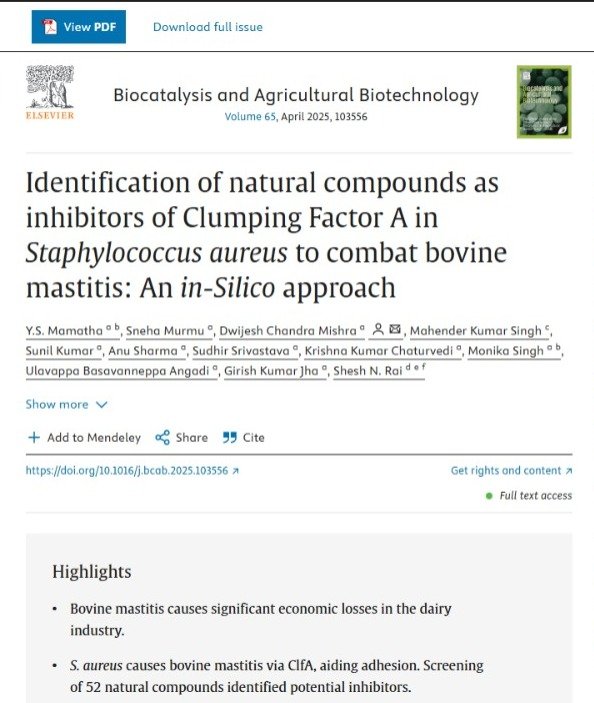
Identification of natural compounds as inhibitors of Clumping Factor A in Staphylococcus aureus to combat bovine mastitis: An in-Silico approach
Y.S. Mamatha, Sneha Murmu, Dwijesh Chandra Mishra, Mahender Kumar Singh, Sunil Kumar, Anu Sharma, Sudhir Srivastava, Krishna Kumar Chaturvedi, Monika Singh, Ulavappa Basavanneppa Angadi, Girish Kumar Jha, Shesh N. Rai